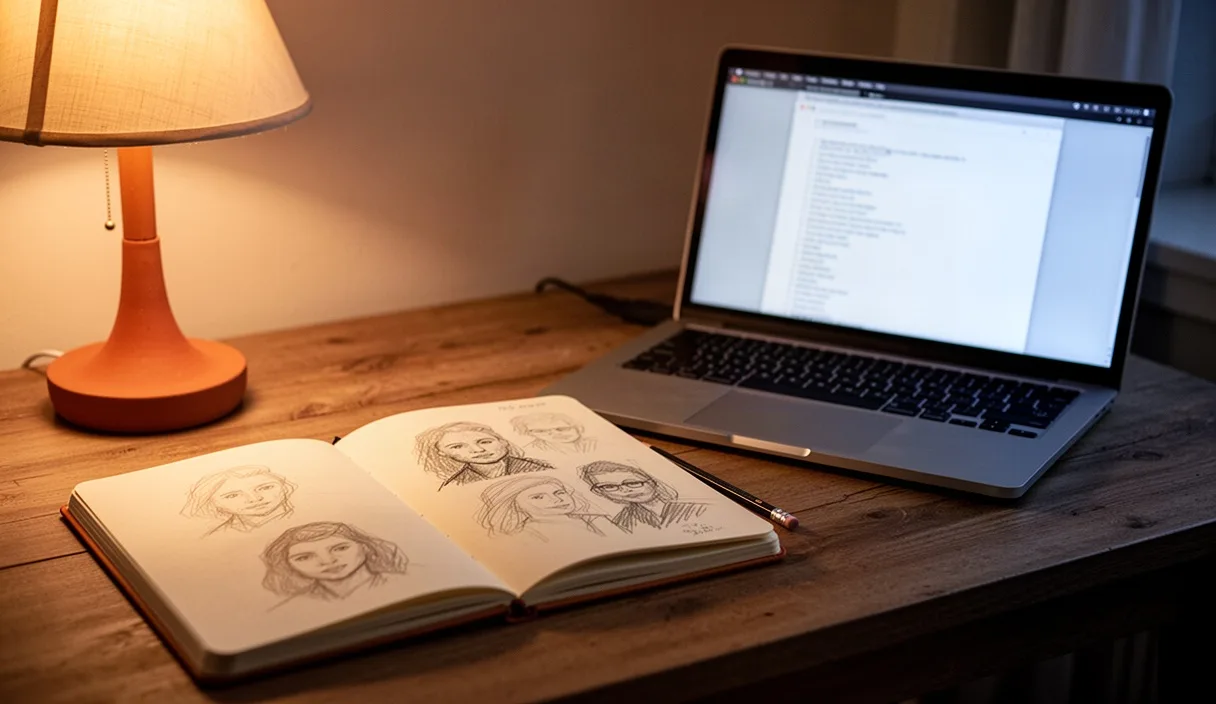
We keep two logbooks on the studio shelf, and they do not do the same job. One is a sketchbook with bent corners and a rubber band holding it shut, full of graphite smudges and coffee rings. The other is a plain notebook, sometimes a spreadsheet, where we record the exact wording we fed into an image generator, the settings we used, and what came out the other end. Both are records of looking and deciding, but they capture different kinds of thinking, and mixing them together has cost us work in the past.
This piece is about why we keep the two separate, what goes in each, and how we stitch them back together so neither becomes an island. None of this is precious. It is bookkeeping for a visual practice, and like any bookkeeping, the value shows up months later when you need to find something fast.
Why we keep two separate records
A sketchbook records a hand moving. A prompt log records a conversation with a machine. The pace is different: a sketch might take ninety seconds and a dozen micro-decisions about line weight and proportion, none of which get written down because the marks are the record. A prompt, by contrast, can take three minutes to type and thirty seconds to render, and if we do not write down what we typed, the result is orphaned. We cannot ask the page what it meant.
We tried for about a year to keep one combined notebook, pasting printed thumbnails next to pencil studies. It fell apart for a practical reason: the physical book could not keep up with the volume of generated images, which can run to forty or fifty variations in a single afternoon, while a day of drawing might produce six or eight worked studies. Trying to paste in that volume turned the sketchbook into a scrapbook, and we stopped sketching as often because the book felt cluttered and slow to open.
Separating them let each record stay true to its own rhythm. The sketchbook stays slow and tactile. The prompt log stays fast and searchable. When we need both at once, we cross-reference, which we will get to below, but the daily habit of each stays undisturbed by the other.
What belongs in a physical sketchbook
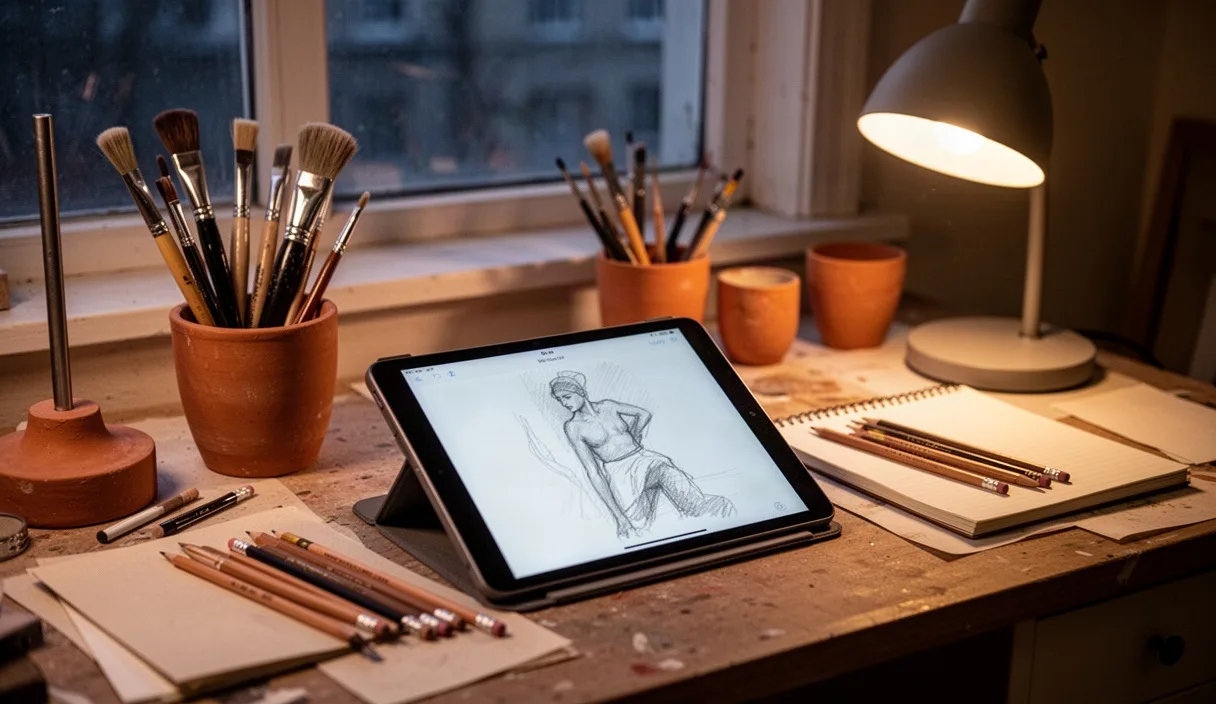
The sketchbook holds anything that came from direct observation or from the hand testing an idea before it has words. That includes life studies, material tests such as a swatch of gouache mixed at three different water ratios, and thumbnail layouts for a composition we have not yet named. We also use it for notes taken during studio visits or gallery trips, because writing by hand while standing in front of a painting slows down the looking in a useful way.
We keep a few habits consistent across books:
- Date every page, top right corner, even rough thumbnails. We use a simple day.month.year format so pages sort chronologically when flipping fast.
- Number the pages in the bottom corner once the book is finished, not as you go, since early pages often get torn out.
- Leave the facing page blank for notes added later, during the weekly review described further down.
- Write the medium and paper weight on the inside cover if the book is used for mixed media, so later you know whether a wash will lift the next page's graphite.
One thing we specifically keep out of the sketchbook is generated reference imagery, even printed small. If a generated image sparks a drawing, we draw from it and note in the margin "from prompt log, page 14" rather than gluing in a printout. This keeps the sketchbook as a record of hand decisions, not a mixed archive, and it keeps the cross-reference habit alive instead of letting images substitute for drawing.
What belongs in a prompt log
The prompt log is closer to a lab notebook than an art journal. For each entry we record the exact prompt text, the model or tool used, any seed number or settings such as aspect ratio and guidance scale, and the date and time. We also note which of the resulting images, if any, we kept or printed, using a simple file name convention like 2024-03-11_lantern-study_03.png so the image file and the log entry can be matched later without guessing.
Beyond the technical settings, we write a line about intent before generating: what problem are we trying to solve by typing this. For example, "need three variations of warm interior lighting on a wooden table, want to see where shadows fall before painting the still life." That sentence matters more than it seems, because six months later the prompt itself will look cryptic without the stated intent attached to it.
We also log failures, briefly, which most people skip. A line such as "prompt produced flat, overexposed light, dropped guidance scale from 9 to 6, better shadow separation" teaches us something about the tool that a kept image alone would not show. Over a year this failure log has become one of the more useful parts of the whole practice, because it shortens the trial and error on future sessions.
| Field | Example entry |
|---|---|
| Date / time | 2024-03-11, 14:20 |
| Tool / model | Midjourney v6 |
| Prompt text | warm interior light on worn oak table, single candle, soft shadow, oil painting texture |
| Settings | ar 3:2, chaos 10, stylize 250 |
| Intent note | checking shadow fall for still life composition |
| Result kept | lantern-study_03.png, used as light reference only |
A simple tagging system that links the two
The two records only earn their keep if we can find the connection between a sketchbook page and a prompt entry fast, without memory alone doing the work. We use a short code written in pencil in the margin of both: a project letter and a number, such as LS-07 for the seventh entry in the "lantern series." That code goes on the sketchbook page, in the prompt log line, and in the image file name if one was kept.
The code does not need to be clever. It needs to be short enough to write quickly in a margin and specific enough that a search in a text file or spreadsheet pulls up every related entry across both records. We keep a one-page index at the front of the current sketchbook listing active project codes, updated by hand whenever a new project starts.
For digital searchability, the prompt log lives in a plain text file or a simple spreadsheet rather than a proprietary app, specifically so a text search for "LS-07" returns every line instantly, including the failure notes. We learned this the hard way after losing access to a note-taking app's search index for a few weeks during a sync issue, which made three weeks of prompt entries temporarily unsearchable.
Reviewing both together once a week
Every Sunday, or whichever day the studio is quiet, we spend around thirty minutes with both books open side by side. The goal is not to generate new work but to notice patterns: which prompts led to sketches that got finished, which sketches never got a matching prompt and might need one, and which project codes have gone quiet for more than two weeks.
During this review we fill in the blank facing pages in the sketchbook with short notes, things like "see LS-09 through LS-12 for light studies that led to this painting" or "drop this direction, three attempts, none held up under daylight." We also flag entries in the prompt log that deserve a proper drawing session, marking them with a small check mark so the next studio day has a built-in task list rather than a blank page and a vague feeling of what to do.
This weekly habit takes less time than it sounds like it should, mostly because both records are already organized by date and code, so the review is scanning rather than reconstructing. Skipping it for two or three weeks running is the fastest way to lose the thread between the two books, since the codes stop meaning anything once enough time has passed that we cannot recall what LS-14 was about without digging.
What gets lost if you only keep one
Keeping only a sketchbook means the record of machine-assisted exploration disappears the moment we close the generation tool, taking with it the specific wording that produced a useful result. We have tried to reconstruct a prompt from memory a handful of times and gotten close but never exact, and the small differences in wording produce noticeably different lighting or texture, enough to matter for a painting reference.
Keeping only a prompt log, on the other hand, slowly erodes hand skill, because every visual problem gets solved by typing rather than by observing and drawing. We noticed this directly after a stretch of about two months where prompt logging had replaced sketching almost entirely. Figure proportions in our own drawings had gotten noticeably stiffer, and it took several weeks of daily life drawing to loosen back up. That is not a universal outcome, and anyone worried about a skill plateau in their own practice might be better served talking it through with a drawing instructor than taking our word for it, but it was true for us.
There is also a cost to the review habit itself if only one record exists: half the pattern disappears. A sketchbook alone shows what the hand explored but not what the machine was asked, and a prompt log alone shows what was asked but not what the hand did with the answer. The weekly review only works because there are two threads to compare.
Common mistakes
- Pasting printed generated images directly into the sketchbook, which blurs the record and discourages further drawing from the reference.
- Logging prompts without the intent sentence, leaving a technically complete but practically meaningless entry months later.
- Using a proprietary note app for the prompt log that cannot be searched reliably offline.
- Letting project codes multiply without an index page, so the tagging system becomes its own puzzle.
- Skipping the weekly review for a month and losing the thread between related entries.
Next steps for setting this up
Start with two cheap notebooks rather than anything precious, since the habit matters more than the object at the beginning. Put today's date on page one of each, and write down the first prompt or sketch with a project code even if the project is just "test." Build the index page after the first week, once a few codes actually exist to list.
Set a recurring thirty-minute slot for the weekly review before the habit has a chance to lapse, and treat the first few reviews as practice at scanning rather than expecting deep insight right away. After about six weeks, check whether the tagging codes are still legible and meaningful to you without extra explanation. If they are not, simplify them before the backlog grows any larger.